Showing posts with label family. Show all posts

Sunday, October 14, 2012

Reading


barrowdanny, originally uploaded by AmyEmilia.
Here is an all-time classic photo! My brother Dan - relaxing in a wheelbarrow, holding an umbrella to keep off the rain, and reading. I believe he told me that it was either Swiss Family Robinson, or Robinson Crusoe. Either way, I’m sure the story would be even more gripping when read this way.

We read a lot. After all, there was almost no radio, no television, no mall, and very few other kids to play with at Kivuvu. I read anything and everything, whether I was interested in the subject or not. Reading has been a refuge from the world as well as opening up new vistas.

Our bookshelves were full. The ones I remember right now:
  • Encyclopedia Britannica – a whole set! I read from entry to entry in order. I did not get all the way through although that was a goal.
  • Several dictionaries, including the huge heavy one with the most obscure words. We used that one for Scrabble. Dictionaries were frequently consulted in our house, for all kinds of reasons. I also used them as reading material. Whenever there wasn’t anything else to read, there was always the dictionary! I still enjoy entomology and love trying to figure out the roots of words.
  • A set of Fairy books by Andrew Lang, from Dover Children’s Classics.
  • Indaba, my Children by Vusamazulu Credo Mutwa. Truly a must-read in African oral history and story.
  • Some classic science fiction paperbacks.
  • A few Cherry Ames stories. I especially remember Cherry Ames, Student Nurse.  
  • Several volumes of Reader’s Digest Condensed Books.
  • I’m sure there were some Bibles and inspirational works, probably also a history book or two. Dad’s office had quite a few shelves of medical books.
  • There were a couple cookbooks that got regular use – the Joy of Cooking, and Betty Crocker’s Cooky Book. We had many difficulties with shortages of one thing or another and the Joy of Cooking always came through. I learned to bake from the Cooky Book (although we always spelled it "cookie"). My specialty? Spritz cookies!
  • One favorite pastime of mine was browsing the most recent Wards and Sears catalogs. I spent many hours furnishing my dream room and outfitting myself with new cool clothes. Those catalogs were really our only contact with fashion.  We did get National Geographic magazine once in a while when it didn't get stolen from the post but that wasn't too helpful for current trends.
Once I got to boarding school in Kinshasa, the library at TASOK opened up a much broader world to me. There were hundreds of books, all of which should be read! The librarian gave me a list of books that should be read before college – I think there were about 400 or so – and I methodically read through the entire list of classics before graduation from high school.

In this library I found a GREAT treasure – J.R.R. Tolkien’s book The Hobbit. I devoured that book and The Lord of the Rings when it came out in paperback a couple years later during our furlough in 1969. Those characters (particularly Frodo) are part of my psyche.

Another favorite pastime in the TASOK library was reading magazines. There were many back issues of various strange subjects (or at least, strange to be at TASOK!). I know more about horse breeds, horse racing, ballet, farming, and fashion because of some kind soul’s donation to the library.

Back to the photo for a moment: check out that wheelbarrow! The steel wheel looks home-made to me. Also, I love the broken rib on the umbrella, carefully placed so that the rain wouldn’t fall on Dan’s book – only his back. In the background, you can see the church, which looks freshly painted. There are young mango and avocado trees planted along the semi-circular drive that passed the church and our “front” door. Actually, we used the door on the other side of the house much more, and considered that our front door.

Saturday, October 13, 2012

The Bangu and the Vampa


Bangu in early morning mist, originally uploaded by AmyEmilia.
The missionary houses (and the church) at Kivuvu were, and still are located at the top of a small hill. Our views from the hill were beautiful, and the location was more likely to experience breezes too. We also had many thunderstorms and the hill seemed to attract lightning. (In a later post about storms, I’ll tell the story of the Night the Lightning Bolt Struck the Church.) One of the things that contributed to the view was the silhouette of the Bangu, an uplifted plateau that was just to the southwest of us. 

I don’t think I ever heard another name for the formation. The slopes are very steep, and there are several waterfalls including one we called the Vampa, with pools of beautifully cool water. The photo – taken early in the rainy season I’d say, from the color of the lamb’s tail grass in the foreground – is a somewhat romantic view of the mountain, with fog sliding off the slopes.

The top of the Bangu was much less populated than the area around is, and consequently much more forested. There were rumors of large antelope up there, a lion, perhaps even an elephant. Who knows? I only went to the top twice, once on foot and once by Land Rover. Dad had a survey trip (in which he and several staff members from Kivuvu and IME would go to a village and look over the population for leprosy) and the family went along. What I remember most about that trip was the wonder that the local kids showed when they saw my little sister, blond and pale-skinned as she was. They had never seen a little white kid!

As I said earlier, there were waterfalls to be visited. Getting to the Vampa was quite a hike. First we had to drive to the edge of the river. That took maybe 30-45 minutes. We had to take all food and water with us, as the water was not to be trusted for drinking. The next stage was to cross the river, which was maybe 30 feet across. There was a narrow foot bridge that required climbing up a handmade ladder made from small tree trunks with narrow planks fastened to them at uneven intervals. Once up the ladder, then there was the bridge. About two planks wide, with guide/hand-holds made of vine, it made for an interesting crossing. Sometimes a plank was missing; sometimes the vines were not sturdy. The brown water of the river was only about 10 feet below and looked most uninviting. At the other end of the bridge a similar ladder allowed you back down to the ground, which was best done by “walking” down it like steps, instead of turning around as you might normally expect.

My favorite part of the walk to the Vampa was the mango forest. Someone had planted hundreds of mango trees in a grid – who knows when or why. The project was long abandoned but it made for nice shady walking with a path that rolled up and down the humps made by the tree roots. I think of it as being dark and cool and mysterious, smelling of ripe and rotting mango – and full of snakes.

The Vampa falls were designated as the lower and upper falls. The lower falls were a much shorter trip – maybe an hour walk from the river. Scrambling over the rocks and playing in the clear, cold water was fun. The valley rang with our shouts and laughter as we jumped from the edge of a cascade into the pool below, or slid down the smooth rock slide to the bottom of the upper falls. Swimming here was a relief from the heat and humidity of the rainy season and we relished it!

Once, Garcia (our gardener, previously mentioned here) and Pedro, our houseboy, went with my brother George and I for the strenuous hike to the very top of the plateau. I do not recall who else was with us. What I do remember is the struggle to get up the steep rocky path – I was never the most athletic or fit kid – and even worse, the trip down. My knees were water, my thighs on fire. A brutal hike. On that same trip, I fell on the final ladder, putting my leg between the slats and deeply bruising my shin. Garcia and Pedro started laughing as I started to tear up and though I knew why, it still felt cruel. (One was supposed to laugh at pain or fear, to keep the bad spirits away.) I had a knot on that shin for years afterwards.

On another occasion, I was walking with Dr. and Mrs. Frazier, running up and down the small hummocks in the path. Serious miscalculation caused me to land on my left knee resulting in a deep jagged gash. It took weeks to heal. That scar still reminds me to pay attention on uneven ground!

Tuesday, October 9, 2012

Hats

This post is mostly about the continuing presence of Congo in our family life.  I spent the most formative years of my childhood in Africa – from age 5 to age 17, with a couple years of furlough back at a place in the States called “home” that never was actually home. Little bits of Congo are scattered all over my life, underpinning my decisions, coloring my outlook.  Surely everyone's childhood stays with them in such ways.  I still carry a  poem in my wallet that I wrote while suffering severe homesickness during a Stateside furlough… “home, I long to go home, back to the Congo”.  Africa truly never leaves the soul. 

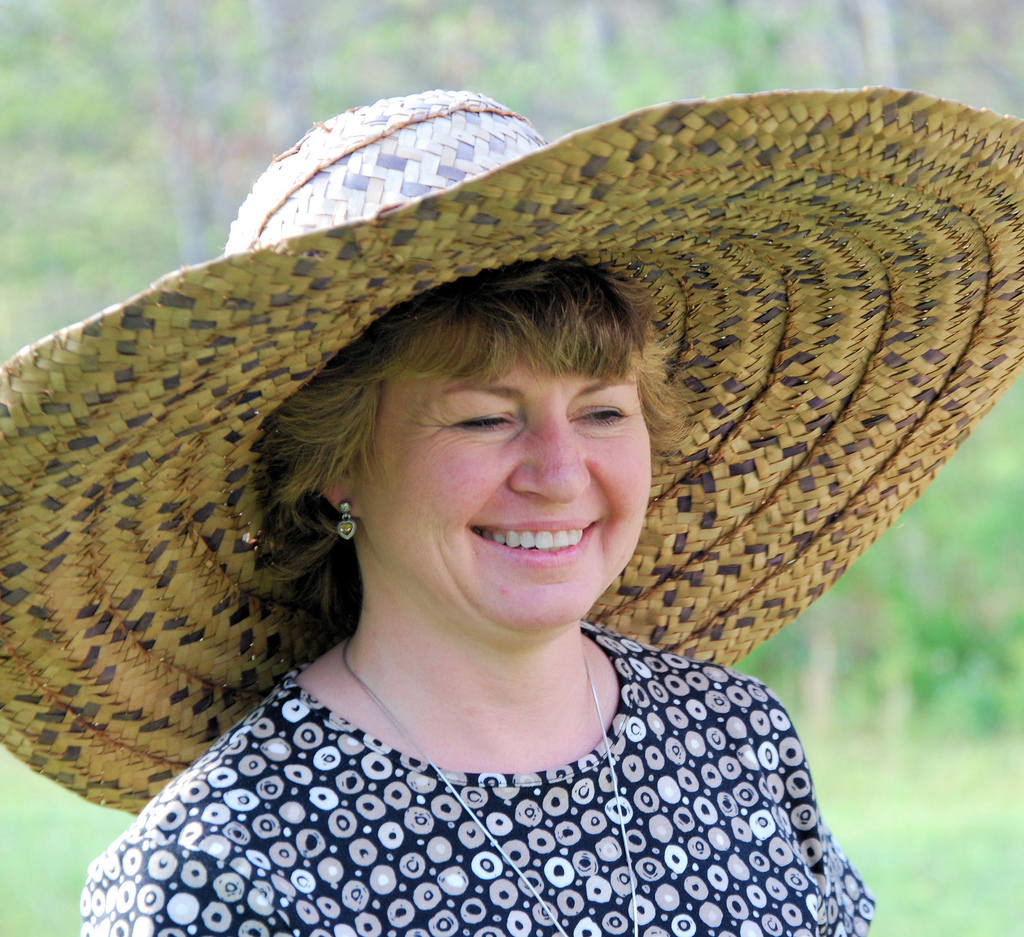
So what does all that have to do with hats?  I’ll show you!  We have two very broad-brimmed hats made of some kind of fiber, with a  few purple bands decorating the weave.  These hats were acquired at some point in Kivuvu – possibly brought to the back door by a vendor. There often was someone at the back door, with live mice in woven traps for our pet mongoose, or carvings, or vegetables, a giant stalk of bananas, or… hats.  The hats made for wonderful child portraits.  Here, my little sister Sara gives us such a beautiful smile!

Next, my brother Dan, a bit more thoughtful:

 
 And finally, my brother George and his fellow adventurer Tommy, determined!  
Note the slingshot around George’s neck, the dirt and scrapes on both boys, the general lack of decent footwear.  These guys were heading out to the wild bush! The big hat was all part of the package.
Forty years later, more or less, our family was together again for a Thanksgiving celebration at my sister’s place.  The Congo hats came out again, to be savored and played with.  I took a deep sniff of the brim, and thought I smelled a bit of Congo still in the fibers.  Those hats traveled with us from Congo to Hawaii to Pennsylvania to Maryland, and are part of our family heritage. They may not last  another forty years, but I’m glad we still have them now. 
 
Sara is still has her charming smile,


George still has a slingshot at the ready,

Dan is still pensive.
 
But we still get goofy,


and hide behind the brim,

with smiles all around.


The next generation likes the hats too! 


I'm so glad we have each other to share those memories.  When we get together it is so much fun to tell the stories, to hear new tales, to remember the good times and the bad. Our family was hardly perfect - still isn't - but that shared experience means so much to me.  No one else knows quite what it was like to be us, then. 
 

Thursday, October 4, 2012

Gardening at Kivuvu


kivuvu garden 3, originally uploaded by AmyEmilia.
My dad is a talented gardener, and he really got to exercise those talents at Kivuvu. Our garden was the source of most daily vegetables. Grocery stores were non-existent, and although peddlers did bring vegetables to the back door it was on an irregular basis. Here is a shot of our garden, in about 1967, two years after we arrived. It looks to me as though Dad took it by standing on the washblock and putting the camera up over his head.  That's my sister Sara touring the garden with Jeremiah, the black cat. (He was named after the prophet Jeremiah in the Bible, because of his continual lamentations. A very talkative cat! Sometime I’ll have to tell you the story about the end of Jeremiah – it’s not a happy end.)

Our climate in Kivuvu was hot and wet during the rainy season, and dry and cool during shivu, the dry season. This photo was definitely taken during the rainy season, since I see the endive and collards (?) are bolting. The rainy season was slightly longer than the dry season, running from October through May. During that season we could expect daytime temperatures in the upper 90’s and nighttime temperatures in the 70’s. Skies were blue, with lots of puffy white clouds. Rain came in the form of huge thunderstorms. Since the station was on a hill, lightning strikes often accompanied these storms. (A particularly dramatic lightning storm will be written up soon!)

The dry season ran from June through September. Daytime temperatures were in the 70’s, and nighttime temperatures could drop as low as the high 50’s. During the dry season there was no rain whatsoever, although because of the continuous presence of grey, low hanging clouds you would expect rain. As the season advanced, the dust would get thicker and the well-water became muddier.

Gardening was quite different in the two seasons. The rain and heat of the rainy season meant that tomatoes and peppers and eggplant did very well. You can see lettuce and endive in the garden, but those would be hold-overs from the dry season garden, when cool weather crops did better. Late lettuce was always so bitter due to the heat. Pineapples also grew well. In a large field off to the right, we sometimes grew peanuts, sweet potatoes and field corn.

Off in the distance you can see the profile of the Bangu mountain. In between us and the Bangu was a cattle ranch full of half-wild cows with dangerous horns, and other wildlife. Most of the big animals were long gone from this part of Congo – the biggest might be a small antelope. Lots of snakes and mongooses, field rats and pythons, large and small birds of all kinds. The fields were burned off annually to control the regrowth of the forest and promote good grazing for the cattle.

Fortunately for the Meyers table, we had help with our garden. The main gardener was Garcia, an Angolan refugee who was a cool dude as well as a good worker. You can see that he took good care of the garden! Dad and Mom instructed him on how the garden should be maintained, and he did a great job of keeping it up.

Wednesday, October 3, 2012

Driving to Jacques Foret


driving in the sugar fields, originally uploaded by AmyEmilia.
For a change of pace, let’s head out to the sugarcane plantation near Lukala, maybe 20-30 miles from Kivuvu. Lukala also had the ONLY cement factory in Bas-Congo, if not in the entire country. And we often got bread from there (leading to the family joke that Lukala bread was hard as a rock). I also remember touring the sugar factory, and seeing the great vats of molasses.

The reason we were driving through these tall canes was to get to a wonderful place called Jacques Foret, a spring-fed pond with incredibly clear water and a spooky cave. I only made it out there a couple times, since this qualified as both a big time commitment for my parents as well as a hassle to get permission to cross the fields. The road wasn’t bad as I recall, but obviously the view was restricted and those sharp-edges leaves cut the arms of the unwary who left the windows open.


But Jacques Foret was well worth the effort, as you can see. The water was crystal clear, cold, and deep. A few fallen trees floating in the water provided a place to hang on. The cave (no photos, unfortunately) was flooded most of the way in, and did have bones in it. I can’t quite trust my memory on if they were human but they may have been. Certainly this area would have been well-known to the local folks for its wonderful water.

Dad had fewer reservations about us swimming in this water since it was fast-flowing.  In stagnant water there was always the risk of schistosomiasis (sleeping sickness or bilharzia).  Oddly, I don't remember any mosquito population here, but I'm sure there were some.

My predominant memories of this oasis are coolness, and peace, and a bit of edginess about the cave.  I'd love to go back and see if it has changed in the last 40 years! 

Monday, October 1, 2012

Welcome to Kivuvu - September 1965

"Soyez les bien venus". Roughly translated by my now very rusty French, this sign reads: "They are the welcome ones". This sign was erected to celebrate and welcome the Meyers family to Kivuvu. Kivuvu means "place of hope" in Kikongo, as I recall. My father is a doctor, and this little mission station housed the leprosarium. Fortunately for the patients, my dad's specialty is leprosy and tropical disease.

We would live here at Kivuvu until 1973, with a furlough back to the States in 1969 (just in time to watch the moon landing!). Looking at the photo, I remember how desolate and bleak Kivuvu looked when we got there. Of course it was the very end of dry season, which didn't help. By the time we left in June of 1973 there would be rows of mango and oil palm trees lining the roads, and flowers too.

The house behind us was for Edna and Jean, two single missionaries from England. Edna was a nurse, and Jean a teacher. I learned a lot from both of them, and especially enjoyed their holiday celebrations. Edna's marzipan Christmas cake was wonderful! You can see that Edna and Jean were newly arrived as well, although I don't remember when they came. There are packing crates to the left, and those wouldn't have stayed out for long. Further to the left is their rabbit house. The rabbits were an experiment doomed to fail. Once the python population discovered these bite-sized snacks, they were constantly stopping by.

Our house was of similar concrete block and corrugated tin roof construction, and is located off-screen and to the right. I'll post another photo later.

Friday, June 11, 2010

Road trip!

Headed to my bother's place, to see my neice's first dance recital.  Should be fun!  :) 

Wednesday, August 19, 2009

my dad


laughing, originally uploaded by AmyEmilia.

I love this photo of my dad. It embodies so many memories. I am thinking of him this evening, because in searching for something else, I ran across a list that we made together at the kitchen table, in September 2004. Somehow the conversation came around to the various jobs that his father, my Grandpap, had done during his life. Grandpap died when I was about 6, but I remember a tall man with huge hands, who seemed a bit grim. Photographs show broad shoulders, large features, strong-looking. He died young, in his early 70's I think, in about 1961. Here is list of the jobs that his father had, in the order that his son remembered them:

  • farmer (this would be in rural Pennsylvania, in a narrow valley near Tussey Mountain)
  • road builder
  • coal miner at age 12, in Elizabeth
  • carpenter at the power plant in Saxton
  • timber hauler
  • tunnel and bridge builder
  • led a rigging gang in a steel mill in Monassan (not sure I got that right, sometimes my writing is hard to read!)
  • coke screener in Johnstown
  • railroad bridges
  • constable
  • treasurer of the school board, Hopewell Township
  • state inspector for highway construction on Highway 70, from about Town Hill to Breezewood

I also know that Grandpap was a devout Democrat - one time we found the precinct lists. He was away from home a lot, which left my Grandma to raise her five sons mostly on her own. The farm provided most of the food they needed, but cash was needed too. Grandpap's jobs brought in enough! Interesting how many of them are in the construction/engineering area.

Thursday, November 27, 2008

Thanksgiving part 1

Yesterday we flew from Houston to BWI to begin the Thanksgiving holiday with my family. Our Continental flight left at 7:25 AM and so we were up at 4AM to get ourselves out the door by 4:30AM. I was concerned about parking but when we got to my preferred floor 7 of the Terminal E parking garage, it was almost empty! Getting through security was quick, we had 2 people in front of us. We spent an hour in the President's Club getting coffee and reading the paper. There was a nice surprise waiting for us at the gate, because when I went up to counter and asked about a possible companion upgrade I found they had already upgraded us. So we had first class seats and very nice service. And yet another breakfast! We arrived in Baltimore on time and got the rental car quickly (another free upgrade too). I don't know if leaving early was the key, but we had absolutely no trouble with our inbound travel. A big relief.

DH seems to have stood the trip well, no distress on the flight. I am so grateful for that. And today he is cheerful and ate a good breakfast of waffles and jam and coffee. Hopefully the healing process is well on its way.

Wednesday, November 5, 2008

Thursday and Friday

As some of you know, my husband went to the hospital last night while I was in Tampa, complaining of very severe stomach pain. They kept him overnight, and have done several blood tests and a CAT scan.

The diagnosis is gallstones. He has to have the gall bladder removed, as well as the gallstones themselves, which are lodged in the bile duct. The removal of the gallstones is done endoscopically, and is scheduled for mid-morning tomorrow. If all goes well, then the following day (Friday) they will remove the gall bladder. He should be home on Saturday.

He is feeling wretched right now, lots of nausea and fever/chills. They've started him on antibiotics and gave him a good shot of Demerol (pain) and phenargan (nausea). He's also on oxygen. When I left him the Demerol had taken effect and he was sleeping.

He looks so vulnerable...

Monday, August 25, 2008

up in the air again


rainbow storm, originally uploaded by AmyEmilia.

I'm traveling, seems like I haven't spent much time at home lately. Visited my parents for several days - lots of fun but not much sleep. Now in Tampa for work, and back to Houston on Tuesday. But only two days and I'll be back onthe road again, this time to South Padre for the Labor Day holiday. Hopefully the weather will be cooperative!

Sorry to be such a poor correspondent...

Sunday, August 17, 2008

a moment of contentment between man and bird

Had a lovely visit from my brother and his family - including their Senegal Parrot, Sam. He's got an agressive looking beak (the bird, not my brother!) but actually is pretty peaceful unless you sneak up on him. They have had him since 2001 so in Senegal Parrot Years he is about middle age. Oddly so is my brother! :)

Tuesday, July 8, 2008

Wyland wall worshipping...


worshipping the wyland, originally uploaded by AmyEmilia.

I know I've been silent for a long time - and this picture tells you a little about where I've been. My sister and her family came to visit us down on South Padre Island - we had a wonderful time. The Island is a great place to just hang out. Not a lot of big sights to see (althoughSchlitterbahn Water Park got high marks) but plenty of space for a family to run and play and eat.

The artist Wyland painted this wall in May 1994. It is part of the South Padre Island Convention Center. The side where we were playing around (the south side) also has an area of native trees and flowers to attract birds and butterflies. The boys had a great time making shadows in the spotlights!

The weather cooperated most of the time so we were able to spend time building sandcastles and lazing around on the beach. Afternoon naps, feeding the local cats, investigating local stores (Art Sea has some nice art and cool stuff!), eateries... all good fun. Some places I haven't been before, like Fishbones - really good fried shrimp in an entertaining venue. Or the local pizzeria, D'Pizza Joint , which features a brick, wood-fired oven and lots of local color. (Good pepperoni, by the way!)

My sister and I had not vacationed together since we were children, so this was a special week. I am so glad it was possible!

Sunday, June 15, 2008

My dad and I

Wayne and Amy 1956, originally uploaded by AmyEmilia.

We both look so young! Dad was still in medical school, and I was maybe 6 months old? Not sure. My mom took the picture. She told me that at one time, they had $0.13 in the bank. But they never skimped on photos - there are quite a few that have survived the years so I suppose there were even more.

My dad... well... what can anyone really say about their dad?

Mine is

  • Special, of course!
  • Dedicated, hard-working, smart, tells a great story, kind, funny, quietly courageous, and humble.
  • Known world-wide for his scientific endeavors (although you wouldn't hear it from him).
  • Speaks French fluently, and I'm sure his Kikongo, Swahili, Lingala, and German would brush right up with some use.
  • Even in his retirement he still works to better the lives of those suffering from tropical diseases.
  • Together with my mom, he has raised 4 kids who all managed to succeed in their various ways.

I feel so lucky to be their daughter. Thanks Dad and Mom!

AddThis

Bookmark and Share