Showing posts with label memory. Show all posts

Sunday, October 14, 2012

Reading


barrowdanny, originally uploaded by AmyEmilia.
Here is an all-time classic photo! My brother Dan - relaxing in a wheelbarrow, holding an umbrella to keep off the rain, and reading. I believe he told me that it was either Swiss Family Robinson, or Robinson Crusoe. Either way, I’m sure the story would be even more gripping when read this way.

We read a lot. After all, there was almost no radio, no television, no mall, and very few other kids to play with at Kivuvu. I read anything and everything, whether I was interested in the subject or not. Reading has been a refuge from the world as well as opening up new vistas.

Our bookshelves were full. The ones I remember right now:
  • Encyclopedia Britannica – a whole set! I read from entry to entry in order. I did not get all the way through although that was a goal.
  • Several dictionaries, including the huge heavy one with the most obscure words. We used that one for Scrabble. Dictionaries were frequently consulted in our house, for all kinds of reasons. I also used them as reading material. Whenever there wasn’t anything else to read, there was always the dictionary! I still enjoy entomology and love trying to figure out the roots of words.
  • A set of Fairy books by Andrew Lang, from Dover Children’s Classics.
  • Indaba, my Children by Vusamazulu Credo Mutwa. Truly a must-read in African oral history and story.
  • Some classic science fiction paperbacks.
  • A few Cherry Ames stories. I especially remember Cherry Ames, Student Nurse.  
  • Several volumes of Reader’s Digest Condensed Books.
  • I’m sure there were some Bibles and inspirational works, probably also a history book or two. Dad’s office had quite a few shelves of medical books.
  • There were a couple cookbooks that got regular use – the Joy of Cooking, and Betty Crocker’s Cooky Book. We had many difficulties with shortages of one thing or another and the Joy of Cooking always came through. I learned to bake from the Cooky Book (although we always spelled it "cookie"). My specialty? Spritz cookies!
  • One favorite pastime of mine was browsing the most recent Wards and Sears catalogs. I spent many hours furnishing my dream room and outfitting myself with new cool clothes. Those catalogs were really our only contact with fashion.  We did get National Geographic magazine once in a while when it didn't get stolen from the post but that wasn't too helpful for current trends.
Once I got to boarding school in Kinshasa, the library at TASOK opened up a much broader world to me. There were hundreds of books, all of which should be read! The librarian gave me a list of books that should be read before college – I think there were about 400 or so – and I methodically read through the entire list of classics before graduation from high school.

In this library I found a GREAT treasure – J.R.R. Tolkien’s book The Hobbit. I devoured that book and The Lord of the Rings when it came out in paperback a couple years later during our furlough in 1969. Those characters (particularly Frodo) are part of my psyche.

Another favorite pastime in the TASOK library was reading magazines. There were many back issues of various strange subjects (or at least, strange to be at TASOK!). I know more about horse breeds, horse racing, ballet, farming, and fashion because of some kind soul’s donation to the library.

Back to the photo for a moment: check out that wheelbarrow! The steel wheel looks home-made to me. Also, I love the broken rib on the umbrella, carefully placed so that the rain wouldn’t fall on Dan’s book – only his back. In the background, you can see the church, which looks freshly painted. There are young mango and avocado trees planted along the semi-circular drive that passed the church and our “front” door. Actually, we used the door on the other side of the house much more, and considered that our front door.

Saturday, October 13, 2012

The Bangu and the Vampa


Bangu in early morning mist, originally uploaded by AmyEmilia.
The missionary houses (and the church) at Kivuvu were, and still are located at the top of a small hill. Our views from the hill were beautiful, and the location was more likely to experience breezes too. We also had many thunderstorms and the hill seemed to attract lightning. (In a later post about storms, I’ll tell the story of the Night the Lightning Bolt Struck the Church.) One of the things that contributed to the view was the silhouette of the Bangu, an uplifted plateau that was just to the southwest of us. 

I don’t think I ever heard another name for the formation. The slopes are very steep, and there are several waterfalls including one we called the Vampa, with pools of beautifully cool water. The photo – taken early in the rainy season I’d say, from the color of the lamb’s tail grass in the foreground – is a somewhat romantic view of the mountain, with fog sliding off the slopes.

The top of the Bangu was much less populated than the area around is, and consequently much more forested. There were rumors of large antelope up there, a lion, perhaps even an elephant. Who knows? I only went to the top twice, once on foot and once by Land Rover. Dad had a survey trip (in which he and several staff members from Kivuvu and IME would go to a village and look over the population for leprosy) and the family went along. What I remember most about that trip was the wonder that the local kids showed when they saw my little sister, blond and pale-skinned as she was. They had never seen a little white kid!

As I said earlier, there were waterfalls to be visited. Getting to the Vampa was quite a hike. First we had to drive to the edge of the river. That took maybe 30-45 minutes. We had to take all food and water with us, as the water was not to be trusted for drinking. The next stage was to cross the river, which was maybe 30 feet across. There was a narrow foot bridge that required climbing up a handmade ladder made from small tree trunks with narrow planks fastened to them at uneven intervals. Once up the ladder, then there was the bridge. About two planks wide, with guide/hand-holds made of vine, it made for an interesting crossing. Sometimes a plank was missing; sometimes the vines were not sturdy. The brown water of the river was only about 10 feet below and looked most uninviting. At the other end of the bridge a similar ladder allowed you back down to the ground, which was best done by “walking” down it like steps, instead of turning around as you might normally expect.

My favorite part of the walk to the Vampa was the mango forest. Someone had planted hundreds of mango trees in a grid – who knows when or why. The project was long abandoned but it made for nice shady walking with a path that rolled up and down the humps made by the tree roots. I think of it as being dark and cool and mysterious, smelling of ripe and rotting mango – and full of snakes.

The Vampa falls were designated as the lower and upper falls. The lower falls were a much shorter trip – maybe an hour walk from the river. Scrambling over the rocks and playing in the clear, cold water was fun. The valley rang with our shouts and laughter as we jumped from the edge of a cascade into the pool below, or slid down the smooth rock slide to the bottom of the upper falls. Swimming here was a relief from the heat and humidity of the rainy season and we relished it!

Once, Garcia (our gardener, previously mentioned here) and Pedro, our houseboy, went with my brother George and I for the strenuous hike to the very top of the plateau. I do not recall who else was with us. What I do remember is the struggle to get up the steep rocky path – I was never the most athletic or fit kid – and even worse, the trip down. My knees were water, my thighs on fire. A brutal hike. On that same trip, I fell on the final ladder, putting my leg between the slats and deeply bruising my shin. Garcia and Pedro started laughing as I started to tear up and though I knew why, it still felt cruel. (One was supposed to laugh at pain or fear, to keep the bad spirits away.) I had a knot on that shin for years afterwards.

On another occasion, I was walking with Dr. and Mrs. Frazier, running up and down the small hummocks in the path. Serious miscalculation caused me to land on my left knee resulting in a deep jagged gash. It took weeks to heal. That scar still reminds me to pay attention on uneven ground!

Tuesday, October 9, 2012

Hats

This post is mostly about the continuing presence of Congo in our family life.  I spent the most formative years of my childhood in Africa – from age 5 to age 17, with a couple years of furlough back at a place in the States called “home” that never was actually home. Little bits of Congo are scattered all over my life, underpinning my decisions, coloring my outlook.  Surely everyone's childhood stays with them in such ways.  I still carry a  poem in my wallet that I wrote while suffering severe homesickness during a Stateside furlough… “home, I long to go home, back to the Congo”.  Africa truly never leaves the soul. 

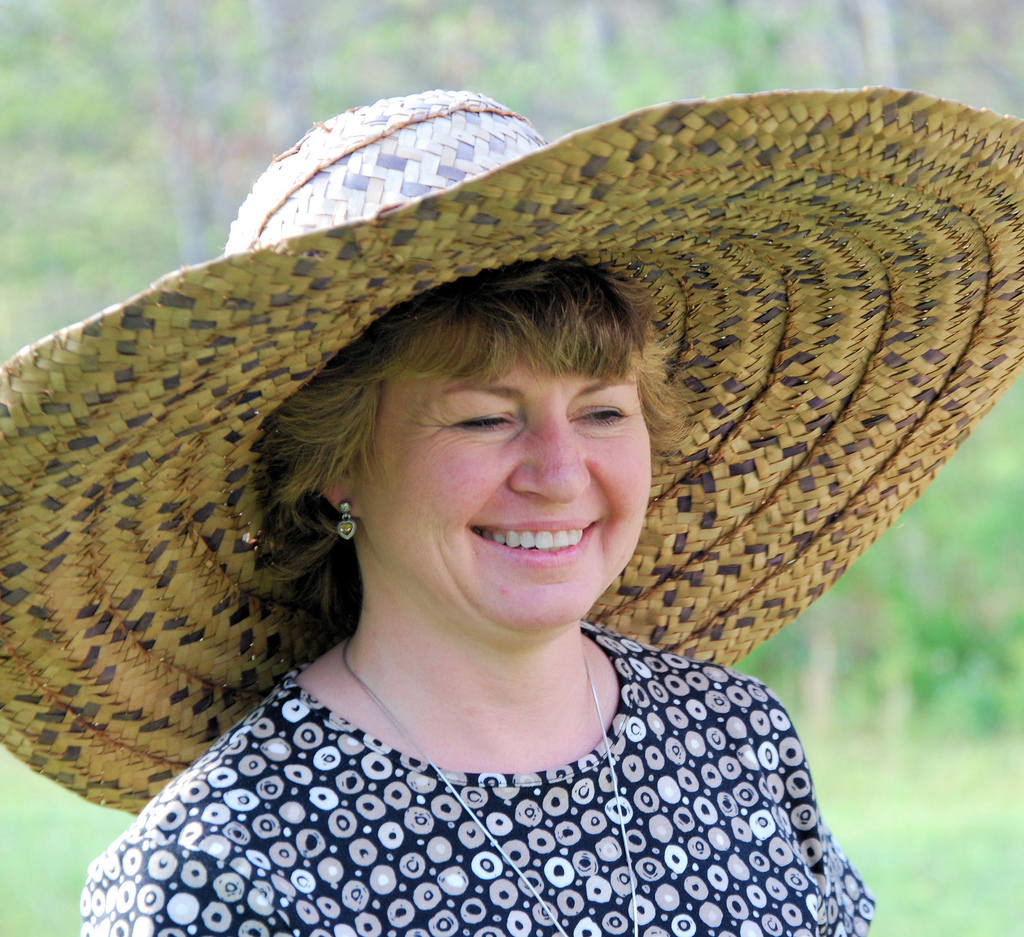
So what does all that have to do with hats?  I’ll show you!  We have two very broad-brimmed hats made of some kind of fiber, with a  few purple bands decorating the weave.  These hats were acquired at some point in Kivuvu – possibly brought to the back door by a vendor. There often was someone at the back door, with live mice in woven traps for our pet mongoose, or carvings, or vegetables, a giant stalk of bananas, or… hats.  The hats made for wonderful child portraits.  Here, my little sister Sara gives us such a beautiful smile!

Next, my brother Dan, a bit more thoughtful:

 
 And finally, my brother George and his fellow adventurer Tommy, determined!  
Note the slingshot around George’s neck, the dirt and scrapes on both boys, the general lack of decent footwear.  These guys were heading out to the wild bush! The big hat was all part of the package.
Forty years later, more or less, our family was together again for a Thanksgiving celebration at my sister’s place.  The Congo hats came out again, to be savored and played with.  I took a deep sniff of the brim, and thought I smelled a bit of Congo still in the fibers.  Those hats traveled with us from Congo to Hawaii to Pennsylvania to Maryland, and are part of our family heritage. They may not last  another forty years, but I’m glad we still have them now. 
 
Sara is still has her charming smile,


George still has a slingshot at the ready,

Dan is still pensive.
 
But we still get goofy,


and hide behind the brim,

with smiles all around.


The next generation likes the hats too! 


I'm so glad we have each other to share those memories.  When we get together it is so much fun to tell the stories, to hear new tales, to remember the good times and the bad. Our family was hardly perfect - still isn't - but that shared experience means so much to me.  No one else knows quite what it was like to be us, then. 
 

Thursday, October 4, 2012

Gardening at Kivuvu


kivuvu garden 3, originally uploaded by AmyEmilia.
My dad is a talented gardener, and he really got to exercise those talents at Kivuvu. Our garden was the source of most daily vegetables. Grocery stores were non-existent, and although peddlers did bring vegetables to the back door it was on an irregular basis. Here is a shot of our garden, in about 1967, two years after we arrived. It looks to me as though Dad took it by standing on the washblock and putting the camera up over his head.  That's my sister Sara touring the garden with Jeremiah, the black cat. (He was named after the prophet Jeremiah in the Bible, because of his continual lamentations. A very talkative cat! Sometime I’ll have to tell you the story about the end of Jeremiah – it’s not a happy end.)

Our climate in Kivuvu was hot and wet during the rainy season, and dry and cool during shivu, the dry season. This photo was definitely taken during the rainy season, since I see the endive and collards (?) are bolting. The rainy season was slightly longer than the dry season, running from October through May. During that season we could expect daytime temperatures in the upper 90’s and nighttime temperatures in the 70’s. Skies were blue, with lots of puffy white clouds. Rain came in the form of huge thunderstorms. Since the station was on a hill, lightning strikes often accompanied these storms. (A particularly dramatic lightning storm will be written up soon!)

The dry season ran from June through September. Daytime temperatures were in the 70’s, and nighttime temperatures could drop as low as the high 50’s. During the dry season there was no rain whatsoever, although because of the continuous presence of grey, low hanging clouds you would expect rain. As the season advanced, the dust would get thicker and the well-water became muddier.

Gardening was quite different in the two seasons. The rain and heat of the rainy season meant that tomatoes and peppers and eggplant did very well. You can see lettuce and endive in the garden, but those would be hold-overs from the dry season garden, when cool weather crops did better. Late lettuce was always so bitter due to the heat. Pineapples also grew well. In a large field off to the right, we sometimes grew peanuts, sweet potatoes and field corn.

Off in the distance you can see the profile of the Bangu mountain. In between us and the Bangu was a cattle ranch full of half-wild cows with dangerous horns, and other wildlife. Most of the big animals were long gone from this part of Congo – the biggest might be a small antelope. Lots of snakes and mongooses, field rats and pythons, large and small birds of all kinds. The fields were burned off annually to control the regrowth of the forest and promote good grazing for the cattle.

Fortunately for the Meyers table, we had help with our garden. The main gardener was Garcia, an Angolan refugee who was a cool dude as well as a good worker. You can see that he took good care of the garden! Dad and Mom instructed him on how the garden should be maintained, and he did a great job of keeping it up.

Wednesday, October 3, 2012

Driving to Jacques Foret


driving in the sugar fields, originally uploaded by AmyEmilia.
For a change of pace, let’s head out to the sugarcane plantation near Lukala, maybe 20-30 miles from Kivuvu. Lukala also had the ONLY cement factory in Bas-Congo, if not in the entire country. And we often got bread from there (leading to the family joke that Lukala bread was hard as a rock). I also remember touring the sugar factory, and seeing the great vats of molasses.

The reason we were driving through these tall canes was to get to a wonderful place called Jacques Foret, a spring-fed pond with incredibly clear water and a spooky cave. I only made it out there a couple times, since this qualified as both a big time commitment for my parents as well as a hassle to get permission to cross the fields. The road wasn’t bad as I recall, but obviously the view was restricted and those sharp-edges leaves cut the arms of the unwary who left the windows open.


But Jacques Foret was well worth the effort, as you can see. The water was crystal clear, cold, and deep. A few fallen trees floating in the water provided a place to hang on. The cave (no photos, unfortunately) was flooded most of the way in, and did have bones in it. I can’t quite trust my memory on if they were human but they may have been. Certainly this area would have been well-known to the local folks for its wonderful water.

Dad had fewer reservations about us swimming in this water since it was fast-flowing.  In stagnant water there was always the risk of schistosomiasis (sleeping sickness or bilharzia).  Oddly, I don't remember any mosquito population here, but I'm sure there were some.

My predominant memories of this oasis are coolness, and peace, and a bit of edginess about the cave.  I'd love to go back and see if it has changed in the last 40 years! 

Tuesday, October 2, 2012

Schoolhouse at IME, Kimpese


Schoolhouse at IME, originally uploaded by AmyEmilia.
This schoolhouse was at the nearby “big” mission, Institut MĆ©dical EvangĆ©lique. A large teaching hospital, the mission was then staffed by many different groups, as well as local folks. (It still functions today! Here is one link.) Our mission, Kivuvu, was located about 20 minutes away. The ride to school was often courtesy of Jean, who drove what she called a “dustbin” – a CitroĆ«n 2CV “Deux-Chaveaux”. The dustbin was a fun car to travel in since it bounced and jounced mightily over the dirt roads.

Many of the mission families had little kids, and so there was a tiny little school for mission kids established. The school taught grades K-5 in English and we had several different nationalities there. I only went for one year (1965-66) before I was sent up to Kinshasa to the American School, to begin 6th grade, although my younger brothers were able to stay. My teacher for that one year was Elizabeth Frazier, wife of one of the staff doctors. Her sons Tim (my age) and Tom (younger) were also in the school. I don’t remember that we had the grades segregated, so it probably functioned the same way as the traditional one-room schoolhouse in the States functioned. While one grade was taught, the rest either worked on their studies or if caught up, listened to the lesson.

I remember NOTHING of the lessons except confusion during math. I skipped over 4th grade and never properly learned my times tables. To this day, my math skills are more intuitive than literal!

As I recall the building consisted of two rooms, with concrete block walls, corrugated tin roof, and mahogany desks, chairs, and doors. Mahogany was the furniture wood of choice, and all the furniture was made right there at IME. Those chairs were heavy! Note also the papaya tree (we called them pie-pies) growing by the side of the building. 

Once the school put on a show for the parents, and one of the spectacles was a rendition of St. George and the Dragon. What remains in my mind is the wonderful green dragon costume that my mother made for me, as well as the applause when my dragon head was cut off (it was attached by snaps) by St. George. There is a delightful photo somewhere in the archives that shows my brother reciting the poem “They That Go Down To the Sea in Ships” by Sir Walter Scott, as his part of the show.

Tuesday, July 20, 2010

Life is dangerous. Life is risky. It's worth it.

Beware of Life

One of the very best essays I have read on the business of life. 

I don't think of myself as particularly courageous or adventurous.  My late cousin Coralee has always been my definition of adventurous - she lived a life full of changes, challenges and stress, but also wonderfully full of love, joy and creative expression.  When I went to visit her in 2002, I was on the brink of making a big decision.  Spending three weeks with her in the deserts of Namibia was a formative experience and I came away from that trip with a better idea of who I am, and what I wanted from life.  When I left she gave me a small envelope which said - DO NOT OPEN UNTIL YOU GET HOME. Once home I opened it and inside there were 6 pair of beautiful little green tourmaline gems, and a single word.  "Remember".  And I do. 

I went ahead with my decision to marry yet again. The ring on my finger has three of those gems, and an engraved reminder:  "Memento Audare Sempre"

Remember always to dare.

Wednesday, August 19, 2009

my dad


laughing, originally uploaded by AmyEmilia.

I love this photo of my dad. It embodies so many memories. I am thinking of him this evening, because in searching for something else, I ran across a list that we made together at the kitchen table, in September 2004. Somehow the conversation came around to the various jobs that his father, my Grandpap, had done during his life. Grandpap died when I was about 6, but I remember a tall man with huge hands, who seemed a bit grim. Photographs show broad shoulders, large features, strong-looking. He died young, in his early 70's I think, in about 1961. Here is list of the jobs that his father had, in the order that his son remembered them:

  • farmer (this would be in rural Pennsylvania, in a narrow valley near Tussey Mountain)
  • road builder
  • coal miner at age 12, in Elizabeth
  • carpenter at the power plant in Saxton
  • timber hauler
  • tunnel and bridge builder
  • led a rigging gang in a steel mill in Monassan (not sure I got that right, sometimes my writing is hard to read!)
  • coke screener in Johnstown
  • railroad bridges
  • constable
  • treasurer of the school board, Hopewell Township
  • state inspector for highway construction on Highway 70, from about Town Hill to Breezewood

I also know that Grandpap was a devout Democrat - one time we found the precinct lists. He was away from home a lot, which left my Grandma to raise her five sons mostly on her own. The farm provided most of the food they needed, but cash was needed too. Grandpap's jobs brought in enough! Interesting how many of them are in the construction/engineering area.

Monday, June 1, 2009

thinking of ice cream


Lately I've discovered Blue Bunny Butter Pecan ice cream. The Premium variety is of course fabulous, but even the No Sugar Added variety is really good. Smooth vanilla studded with pecans - what's not to like?! Eating this ice cream reminded me of the process we used to go through to make it when I was growing up.


Of course, we grew up in tropical Africa. The ingredients weren't always easy to find. Milk was pretty sketchy - I disliked the lumpy, reconstituted powdered milk. The "fresh" kind wasn't too fresh and often was watered down. The eggs were readily available but of uneven quality (not surprising since those hens ran away from things that wanted to eat them 24/7). Eggs usually came to the back door as gifts or for sale by the travelling merchants who also brought us vegetables and ivory carvings and huge stalks of bananas.


My mother would start the night before with a custard ice cream recipe from Joy of Cooking... although looking at my edition (1976, beginning on page 758) it seems we should have had vanilla beans around. I don't remember that. We probably subtituted vanilla flavoring. I remember Mom telling me it never hurts to double the vanilla! We definitely did have evaporated milk, which appears in some of the recipes.


The next day, maybe an early Saturday evening, the churn would come out. I think it was a wood one, and of course was cranked manually. The ice came from the kerosene-powered fridge, the salt probably from the local native market. The promising bucket dropped into the ice, and soon all of us kids took turns turning, and exhorting each other not to stop. Adults take over from time to time when we get distracted. After an interminable, arm-exhausting amount of time, Mom would pronounce it ready. Once in a while we would shave some Cote D'or chocolate into that luscious vanilla before churning.


The ice cream itself was smooth and creamy most of the time, possibly a bit crystalized if we didn't do a good job. Cold felt good on warm tropical evenings! Since our freezer was very small and really not intended for long term storage of anything, we had to eat the whole bucket. Not much of a sacrifice.


Another highlight of making ice cream was daring each other to stand in the ice-water left in the churn bucket. Wow that was COLD!!!! Bare feet in salted icy water - you can't beat it. I can feel my toes going numb just thinking about it.


I don't remember doing this very often - a few times a year perhaps. Then again, I was at boarding school much of the year so perhaps my family had it more often than that. But whenever we made ice cream, we made good food, good fun, and good memories.
Photo credits: the ice cream churn comes from Kalani at Dreamstime. The hibiscus schitzopetalus shot comes from my dad, an excellent photogapher who has preserved the the soft sunset light on film for us to savor over and over again. Thanks Dad!


Thursday, June 12, 2008

Being towed in Alessandria

Alessandria is a lovely city, with a very long history (founded on a "pre-existing urban nucleus" in 1168 according to Wikipedia). I have found it to be friendly and low-key, a quiet place without many tourists. The photo was taken from my sister-in-law's balcony, and it shows a bit of the natural beauty to be found there as well.
In 2003 I was visiting Alessandria (and Italy) for the very first time. We parked in the piazza across from my mother-in-law's apartment, just as we had done a few times before that week. But little did we know, it was Tuesday night, and Wednesday morning was Market Day. Of course we parked about 3 spaces inside the forbidden zone but we weren't paying attention. In the morning, there is NO CAR. NO CAR at all. Just masses of people and trailers and booths. My husband was speechless. We trundled off to where the police station USED to be when he was a child - then were directed back across town to the other police station. Since I was the official renter and driver, I had to be the one to deal with the car. And he said I had a better chance with them as an American tourist than he did as a pissed off former citizen. As we walked he tried to teach me some of what I needed to say, but it was useless. My traumatized brain remembered niente.

I walked into the police station alone (he said he would be arrested if he tried, he was so angry) and found the right place to ask. All I could do was hold up my rental car keys and say "machina, GONE!" with mournful emphasis. The guy behind the desk realized he needed help. Two women from somewhere else in the station began to try and explain things. Then another customer came and helped. Finally, an off-duty policeman who spoke some limited English chimed in. We managed between us to establish that the car was indeed towed. Also that there was a fine - 100 euros I think. After some discussion among my team of helpers, they apparently agreed to waive the fine. They called and asked the towing place to waive the fee but that could not be arranged. I think it was 65 euros. To me this was totally fair and I agreed and thanked them.

Now of course I have the problem that I need to get to the car, and have NO IDEA how to follow directions. My husband is still wisely staying out of sight and I get the feeling that I'm better off without him at this point. The off-duty policeman volunteers to take me to the towing place and unbelievable as it sounds, I hopped right in the car with him. Something I probably wouldn't do in the US! I asked him if there was an ATM since I didn't have the cash, and of course the first ATM we stopped at wasn't working. So in his police car we drive the wrong way up a one-way street, blocking the doorway to the bank - and he waits for me while I go in and get incredibly hosed on the exchange rate but come out with enough cash. Then we are off to the towing yard where there is much smiling and cheerful buongiorno-ing as I pay my towing fee (reduced to 50 euros!). And we have to have a few espressos together with the staff while the lowest guy on the totem pole goes to extract the car. Then my policeman kindly leads me out of the mess, offers to buy me lunch (which I politely decline) and in only three hours that adventure is complete. My poor husband is very happy to see me when I pull up in the piazza.

Ever since, we have been very careful about parking in an open space, and we always read the signs!

Tuesday, May 27, 2008

flamboyant tree

The extravagant flowers of the Poinciana Tree, or Flamboyant, are almost unbelievable. This is a tropical tree, one that I associate very strongly with my childhood in Congo. They really don't have a scent, and yet when I was standing under the tree today, I caught a whiff of Africa in the late afternoon sun.

We are visiting our beach house in South Padre Island for the Memorial Day holiday this week. Just down the street from us, this beautiful little tree is blooming. Because it is a tropical tree, the examples you see here on South Padre Island are quite small. The trees of my childhood would get 20 feet tall at least, and a beautiful umbrella shape. The ones here are perhaps 10 feet tall.

I remember these trees lining the dirt roads, and somewhere there is a charming slide of my little sister swinging from a low branch with such a sweet smile and dusty bare feet. That image of her lives in my heart...

We had quite a few other trees on the station as well - oil palms, mangos (the best were the little ones we called "peach" mangos"), avocados, oxheart, eucalyptus, kapok, and chalmoogra. These last were planted by my father, to see how they would prosper in our climate.

Tuesday, May 20, 2008

elephants on the skeleton coast, namibia


skeleton coast - elephants, originally uploaded by AmyEmilia.

Several years ago, I made a 3-week trip to visit relatives in South Africa and Namibia. One of the truly memorable things that occurred during that trip (ah, so much more to write about...) was this encounter. I am working without notes here, so I may come back and edit this post when those are available.

My cousin and I drive from Palmwag (pronounced pah-lem-bach), through Sesfontein to the Skeleton Coast Camp. Not very many tourists choose this route, but then again, not many tourists are like my cousin. Her Toyota truck is outfitted with two demijohns of petrol, three extra tires on wheels, lots of tools, two sleeping bags, and even a bit of food. We have vague verbal directions, mostly based on time from one landmark to another. What more could you need? Most people fly in but once or twice a year the staff or someone crazy (like us) drives in. The guidebooks suggest a satellite phone and at least one other vehicle traveling with you if you insist on driving north of Sesfontein. These are however only details, and take all the adventure out of it!

The road is sometimes obvious, sometimes a mere suggestion, and sometimes completely non-existent. But somehow, my cousin manages to re-find the trail every time we lose it, and we bounce over rocks, slither over sand, slide down banks, follow dry riverbeds, and find our way inexorably towards the Camp. Fortunately our directions hold up and also fortunately, somewhere outside of Puros we find someone going our way. They lead us in, which is at least another hour (or two?) of driving. The entire trip of maybe 100 miles feels like a lifetime but really only lasts about 6 hours. (On the return trip, when we knew where we were going, we manage to average 18mph.)

Those of you who have stayed at the Camp know its stark beauty, and the wonderful, dedicated staff that make the experience so much richer. We are introduced to our two guides, Chris and Chris. Our Chris is dark-haired, full of mischievous sparkle, confident and so capable that I have no doubt we were in good hands. The other Chris seems to step out of a Hemingway story, with a big leather hat and a story to account for his missing hand, taken by a crocodile somewhere in the past. The morning after we arrive, we go on an all-day game drive with both Chrises.

There are 5 or 6 of us in each of the two vehicles. We bounce along the rocky, sandy roads, stopping here and there to see the wildlife. They look just as interested in us too. A young giraffe pokes his head up over the scrub. Fat healthy gemsbok (oryx) scramble up the hillsides. Birds everywhere, including a rare vulture that I've now forgotten the name of. Jackals, and antelope too, although not very many. We stop at a Himba village to see how these remarkable people manage to make a living herding cattle and goats in the desert. We have tea under an ancient ironwood tree. And, we find elephants. There are perhaps 10 - we spend maybe 20-30 minutes just watching them as they slowly browse the bush. This is a dream fulfilled, to see the famous desert elephants!

The rest of the trip, while exciting, can't top this. We stop for lunch in a dry river bed, and get stuck in the sand. We drive along the Horuseb river, have a flat tire, see impala and (for my cousin the desert dweller this is most exciting) running water in the open desert. Driving back to camp in the dim dusk, we look forward to dinner and bed.

Dinner is a grand sharing of adventures in many languages, and then we gather at the fire and drink too much sherry and whiskey, singing in German and Afrikaans, English and American. Listening to Chris recite Tom Waits lyrics in a Bob Dylan voice far into the night. Sparks from the fire fly up to the burning stars above. I stumble back to our tent and fall asleep thinking of the return drive, map-less but not lost, anticipating the wonders of tomorrow.

Saturday, May 17, 2008

hibiscus schizopetalus

My father took this picture too... I've always loved the original slide, which glows in the setting sun. Obviously I have altered the original, using Virtual Painter.

Sunsets at Kimpese went very quickly - not much twilight when you are near the equator. There were only a few minutes between light and darkness. I remember the sound of the doves cooing, calling one another. And the evening breeze, sighing in the tall grass.

Friday, May 16, 2008

Moments of memory 1


1964 fishing at lake neuchatel, originally uploaded by AmyEmilia.

The first in an occasional series, no particular order. Photos stir memories, layers of smells, sounds, and emotions. Sometimes the photos are mine, but just as often they were taken by others. We all have these moments of memory.

1964 fishing at lake neuchatel

My father took this photo. We were living in Switzerland. My parents were spending a few months learning French, preparing for mission work in Congo. My brothers are "fishing" at Lake Neuchatel. The air is so clear... it didn't happen very often that you could see the Alps.

My experience in Neuchatel was mixed. Since I didn't speak French, I was placed back in 1st grade which really hurt my feelings. Even worse I couldn't understand a word they were saying. And the school contained curriculum that I found boring and very difficult - specifically needlework. But all the girls had to do it. I still have the little sampler I made, beige with red and blue cross stitching at the top and bottom, frayed around the edges and soft with age now.

On the other hand the school was inside the castle, and we had to go across the moat (dry) and through the big gates, all on cobbled streets. I remember walking home with my brother just before Christmas, looking in the sparkling store windows, trying to find a present for Mom, our boots crunching in the snow. We (or more likely, Dad) bought her a beautiful crystal dish. She still has it. And every time I see it, I remember.

French was acquired somehow - it still impedes my attempts to learn Italian. The year we spent in Switzerland was full of changes, but the purity of this moment - the three of us standing at the edge of a luminous lake, darkness closing in but the light still on the far mountains... time stops.

AddThis

Bookmark and Share